
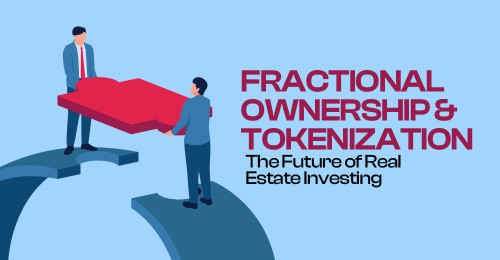
Fractional Ownership & Tokenization: The Future of Real Estate Investing
Real estate has traditionally been viewed as a capital-heavy investment class. For decades, property ownership required substantial upfront funds, access to financing, and long holding periods. This naturally limited participation to high-net-worth individuals and institutional investors.
Today, that structure is evolving.
Fractional ownership and tokenization are redefining how people access real estate, lowering entry barriers and introducing technology-driven efficiency into property investment. For emerging investors, especially in developing markets like Nigeria, this shift represents both opportunity and responsibility.
Understanding how it works is critical.
What Is Fractional Ownership?
Fractional ownership allows multiple investors to jointly own a single property. Instead of one individual buying an entire building, several investors purchase shares in the asset and receive returns proportional to their ownership percentage.
The income generated—whether from rent, lease payments, or eventual sale—is distributed based on the size of each investor’s stake.
This model reduces the capital required to participate in property ownership and spreads risk across multiple stakeholders.
Fractional ownership is not entirely new. It has long existed in commercial real estate through joint ventures and property syndications. What is new is its growing accessibility to retail investors.
What Is Tokenization?
Tokenization builds on fractional ownership by using blockchain technology to digitally represent ownership shares.
In a tokenized real estate structure:
• A property is legally held under a structured entity
• Ownership interests are divided into digital tokens
• Each token represents a fraction of the asset
• Investors purchase tokens through a regulated platform
These tokens can potentially be traded, depending on regulatory approvals and platform structure, improving liquidity compared to traditional real estate.
Tokenization does not eliminate legal ownership requirements. The underlying asset must still be properly structured, documented, and compliant with property and securities laws. The blockchain simply digitizes and streamlines the ownership record.
Why This Model Is Gaining Momentum
Several global trends are driving the rise of fractional real estate:
Lower entry barriers
Investors can participate in high-value assets with smaller capital contributions.
Portfolio diversification
Instead of putting all funds into one property, investors can spread capital across multiple assets in different locations or sectors.
Increased liquidity potential
Traditional real estate is illiquid. Tokenization introduces the possibility of secondary market trading, subject to regulation.
Transparency and record efficiency
Blockchain systems create tamper-resistant ownership records, improving audit trails and reducing administrative friction.
Global participation
Digital platforms enable cross-border participation where regulations permit.
These factors are reshaping investor expectations.
Implications for Emerging Markets
In markets like Nigeria, fractional ownership and tokenization could significantly expand access to real estate.
The country faces a substantial housing deficit and capital constraints. Traditional financing structures often limit property ownership to those with large upfront funds.
Fractional models could:
• Unlock capital from retail investors
• Channel funds into housing development
• Provide structured investment access to diaspora investors
• Improve capital pooling for large-scale projects
However, the regulatory environment remains a critical factor. Property ownership intersects with securities law, land use regulations, and financial compliance frameworks. Any tokenized real estate model must align with national regulations to protect investors.
Risks and Considerations
While promising, fractional ownership and tokenization are not risk-free.
Regulatory uncertainty
If legal frameworks are unclear, investors may face enforcement risks.
Platform risk
The strength and credibility of the managing platform are essential. Governance failures can impact investor returns.
Liquidity assumptions
Although tokenization aims to improve liquidity, secondary markets may not always have sufficient demand.
Asset performance risk
Regardless of structure, property value and rental income still depend on market conditions, location quality, and management efficiency.
Technology risk
Blockchain does not eliminate operational risk. Smart contract vulnerabilities or poor implementation can create challenges.
Education and due diligence remain critical.
How Investors Should Approach This Emerging Model
Investors considering fractional or tokenized real estate should focus on:
Legal structure
Understand how the property is held. Is ownership through a Special Purpose Vehicle? Are you buying equity, debt, or revenue share?
Regulatory compliance
Is the offering aligned with securities regulations? Are investor protections documented?
Asset fundamentals
Technology does not replace real estate fundamentals. Location, demand, cashflow projections, and development quality still matter.
Platform credibility
Evaluate the track record, governance framework, and transparency of the issuing entity.
Diversification strategy
Avoid concentrating all capital into a single tokenized asset.
Fractional ownership should complement—not replace—a well-structured investment strategy.
The Broader Future of Real Estate Investing
The convergence of real estate and financial technology is accelerating. As digital finance expands globally, asset tokenization may become more standardized.
Institutional investors are already exploring blockchain-based real estate transactions. As regulatory clarity improves, retail participation could expand further.
However, the future is likely hybrid rather than purely digital. Traditional ownership structures and tokenized models will coexist, serving different investor profiles.
In emerging economies, success will depend heavily on policy stability, investor education, and regulatory enforcement.
The Role of Structured Education
As new models emerge, information gaps widen. Misunderstanding complex structures can expose investors to unnecessary risk.
Real estate fundamentals remain constant:
• Cashflow analysis
• Risk evaluation
• Legal structuring
• Market demand assessment
• Exit strategy planning
Technology enhances efficiency, but it does not replace these principles.
At the School of Estate and Business, we approach innovations like fractional ownership and tokenization with analytical rigor. We examine not only the technological appeal but also the economic, legal, and structural implications for investors.
Our focus is ensuring investors understand both opportunity and risk before allocating capital.
Fractional ownership and tokenization represent a meaningful evolution in real estate investing. They lower entry barriers, introduce digital efficiency, and potentially increase liquidity.
Yet, they are tools—not guarantees.
The future of real estate investing will likely be more accessible, more technology-driven, and more globally interconnected. Investors who combine technological awareness with strong foundational knowledge will be best positioned to benefit.
As the industry evolves, informed participation—not speculation—will define sustainable success.
