
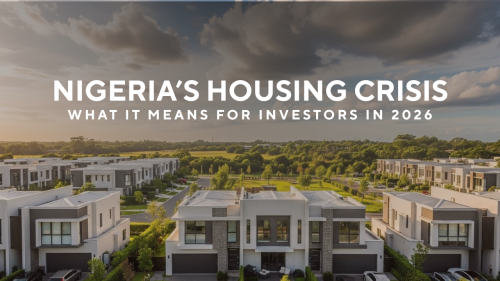
Nigeria’s Housing Crisis: What It Means for Investors in 2026
Nigeria’s housing crisis is often described with one overwhelming figure: the country needs millions more homes.
But behind that figure are real people making difficult decisions every day.
Families are moving farther away from where they work because they cannot afford rent. Young professionals are postponing homeownership. Tenants are accepting smaller spaces or less convenient locations. Developers are struggling to deliver homes at prices ordinary Nigerians can afford, while investors are searching for opportunities that can still produce sustainable returns.
This is the paradox at the heart of Nigeria’s housing market in 2026.
Nigeria needs more housing, yet building and buying housing has become increasingly expensive.
The challenge is significant, but for investors and real estate professionals, it also reveals where some of the most important opportunities in the market may lie.
The Housing Crisis Is Bigger Than a Housing Shortage
When people hear “housing deficit,” it is easy to imagine that the problem simply means Nigeria does not have enough houses.
The reality is more complicated.
A functional housing market needs homes that are not only available, but also affordable, accessible, adequately located, properly serviced and suitable for the people who need them.
A house sitting empty in a distant location does not necessarily solve the housing problem of a worker who needs to live close to employment. Similarly, a luxury apartment may add to the country's housing stock, but it does little to solve the affordability challenges facing a household earning a modest income.
This distinction is becoming increasingly important in 2026.
Recent reporting has placed Nigeria's housing deficit at about 14.9 million units, while also highlighting the enormous increase in construction costs over the past two years. (The Guardian Nigeria)
The exact size of Nigeria's housing deficit varies depending on the methodology and year of the estimate. What is not in serious doubt is the scale of the underlying problem: housing supply is struggling to keep pace with population growth, urbanisation and household demand.
And that gap is where opportunity begins.
Why Is Housing So Difficult to Afford?
There is no single reason Nigerians are struggling to access decent housing.
Several pressures are converging at the same time.
1. The Cost of Construction Has Increased
The economics of property development have changed dramatically.
Cement, steel, roofing materials, electrical fittings, plumbing materials, finishing products and other construction inputs have become significantly more expensive.
Labour and transportation costs also add pressure to development budgets.
When the cost of constructing a house increases, developers ultimately have difficult choices to make.
They can increase selling prices, reduce specifications, delay construction, seek cheaper materials, or change the type and size of properties they develop.
This is one reason why affordability cannot be addressed simply by telling developers to “build more.”
The industry needs to build more efficiently and at price points that match the purchasing power of the market.
2. Access to Mortgage Finance Remains a Major Constraint
For many Nigerians, buying a home outright is simply unrealistic.
In mature property markets, mortgages allow individuals to spread the cost of purchasing a home over many years.
Nigeria's mortgage market remains relatively shallow compared with the size of the housing need.
The cost of borrowing is also a major consideration.
As of July 2026, the Central Bank of Nigeria's Monetary Policy Committee maintained the Monetary Policy Rate at 26.5 percent. (Central Bank of Nigeria)
A high interest rate environment makes borrowing more expensive and can affect both consumers seeking mortgages and developers seeking financing.
This creates a difficult cycle.
The person who needs a home may not have enough cash to buy one.
The developer who wants to build more homes needs financing.
But expensive financing can make both sides of the transaction more difficult.
This is one of the reasons housing finance will remain a critical part of Nigeria's real estate conversation.
3. Urbanisation Is Increasing Pressure on Major Cities
Nigeria's cities are growing.
People move toward economic centres because that is where jobs, businesses, schools, infrastructure and other opportunities are concentrated.
Lagos is a clear example.
As employment and commercial activity expand, demand for housing increases across established neighbourhoods and emerging corridors.
But urban expansion comes with a cost.
As desirable areas become more expensive, residents are pushed toward locations farther from employment centres.
That creates another problem: the cost of transportation becomes part of the cost of housing.
A cheaper apartment that requires a worker to spend several hours and a significant portion of their income commuting may not actually be affordable in practical terms.
This is why the future of Nigerian housing cannot be separated from infrastructure and transportation.
Housing policy, urban planning and transportation policy must increasingly be considered together.
So, What Does the Housing Crisis Mean for Investors?
This is where the conversation becomes particularly interesting.
A housing crisis may sound like a purely negative story.
For investors, however, persistent unmet demand can represent a significant long-term opportunity.
The key is understanding what kind of housing the market actually needs.
Simply buying any property and assuming that it will appreciate is no longer enough.
Investors need to ask better questions.
Who is the end user?
What can they realistically afford?
Where do they want to live?
What infrastructure is available?
What is the rental demand?
What is the potential for capital appreciation?
How easy will it be to resell the property?
These questions shift the conversation from speculation to strategy.
Opportunity 1: Affordable and Mid-Market Housing
Nigeria does not only need luxury apartments and high-end estates.
There is a large market between social housing and premium luxury real estate.
This middle segment includes young professionals, families, small business owners and other households who want decent housing but cannot comfortably afford premium property prices.
For developers who can deliver quality homes at realistic price points, this segment represents a substantial opportunity.
The challenge is achieving affordability without compromising on quality.
That requires smarter land acquisition, efficient designs, appropriate construction methods, bulk procurement, careful infrastructure planning and disciplined cost management.
The winning developers of the future may not necessarily be those building the biggest houses.
They may be those who understand how to deliver good housing efficiently.
Opportunity 2: Rental Housing
Nigeria's housing crisis also creates opportunities beyond homeownership.
Not everyone wants or is immediately able to buy a house.
Some people need rental accommodation because of career mobility. Others are young professionals building their income. Students and workers may need housing close to their institutions or workplaces.
This makes rental housing an increasingly important investment segment.
For investors, rental property can provide two potential sources of return:
Rental income and capital appreciation.
However, rental investment should not be approached simply as “buy a property and increase the rent.”
Successful rental investments require proper market research.
Investors need to understand tenant demographics, vacancy rates, maintenance costs, service charges, neighbourhood development, competing properties and the ability of the target market to pay.
The strongest rental opportunities are often found where there is a consistent reason for people to live in an area.
That could be proximity to employment centres, universities, transport corridors, commercial districts or major infrastructure.
Opportunity 3: Land in Emerging Growth Corridors
As established neighbourhoods become increasingly expensive, development naturally moves outward.
This creates opportunities in emerging locations.
For land investors, the objective should not simply be to purchase large amounts of land and wait.
The smarter strategy is to identify growth corridors before they become fully priced into the market.
Infrastructure is particularly important.
New roads, industrial developments, commercial centres, transport projects and large-scale residential developments can significantly change the attractiveness of surrounding areas.
But investors must be careful.
Not every “upcoming area” will become the next major property hotspot.
Due diligence remains essential.
Before purchasing land, investors should investigate ownership, title, planning restrictions, accessibility, surrounding development, government acquisition risks and the credibility of the seller.
The housing crisis may create opportunity, but it does not eliminate risk.
Opportunity 4: Purpose-Built Housing
Another area worth watching is purpose-built accommodation.
Instead of developing generic residential properties, investors can design housing around specific groups.
Examples include:
Student accommodation
Co-living spaces
Serviced apartments
Workforce housing
Senior living
Short and medium-term rental accommodation
The advantage of this model is that the investment is designed around a specific demand.
For example, an investor developing accommodation close to a major university is solving a very different problem from a developer building luxury apartments in a premium neighbourhood.
The more precisely a development addresses a genuine need, the easier it becomes to understand its market.
The Crisis Also Creates an Opportunity for Real Estate Professionals
The housing challenge is not only an opportunity for property investors.
It is also creating demand for knowledgeable professionals.
As the market becomes more complex, clients need professionals who understand valuation, property management, development, investment analysis, land transactions, market research and regulatory requirements.
The modern real estate professional cannot afford to know only how to sell property.
They need to understand why a property is valuable, who it is valuable to, how the market is changing and what risks are involved.
This is particularly important as technology continues to change how properties are marketed and transactions are conducted.
Knowledge is becoming a competitive advantage.
What Should Investors Be Watching in the Second Half of 2026?
For investors considering the Nigerian housing market, five things deserve close attention.
1. Interest rates
The cost of money affects mortgages, construction finance and investment decisions. With the CBN maintaining the MPR at 26.5 percent in July, financing conditions remain an important factor to watch. (Central Bank of Nigeria)
2. Construction costs
If building costs continue rising, developers may increasingly focus on smaller units, alternative materials, phased developments and more efficient construction methods.
3. Infrastructure
Roads, transport links and other infrastructure can transform the investment potential of emerging locations.
4. Rental demand
As homeownership remains difficult for many households, rental housing will continue to play a central role in the market.
5. Affordability
Perhaps most importantly, investors need to pay attention to what people can actually afford.
A property can be beautifully designed and located in a promising neighbourhood, but if the target market cannot afford it, demand may remain weak.
The Bigger Picture
Nigeria's housing crisis should not be viewed only as a problem to be solved.
It is also a reflection of a market with enormous unmet demand.
Millions of people need homes.
Businesses need accommodation for workers.
Students need places to live.
Families need better housing.
Young professionals need affordable rental options.
Cities need well-planned communities.
Investors need productive assets.
Developers need sustainable business models.
The opportunity lies in connecting these needs.
The real estate investors who thrive in this environment will not necessarily be those who simply own the most properties.
They will be those who understand the market deeply enough to identify where demand exists, what people can afford and how to create value around those needs.
Final Thoughts: The Housing Crisis Needs More Than Houses
Nigeria does not simply need more buildings.
It needs better housing solutions.
That means housing that is affordable, accessible, properly planned, adequately serviced and connected to the economic realities of the people who will live in it.
It also means creating an environment where developers can build sustainably, investors can invest with confidence, and households can access long-term financing.
For investors, the message is clear.
The housing shortage is not going away overnight.
That means the demand for housing will remain one of the defining forces in Nigeria's real estate market for years to come.
But opportunity will belong to those who look beyond the shortage itself.
Look at the people behind the demand.
Look at their income.
Look at their location.
Look at their lifestyle.
Look at the infrastructure around them.
Look at what they can afford.
And most importantly, look at the problem your investment can actually solve.
Because in a market with millions of unmet housing needs, the biggest opportunity may not be in simply owning property.
It may be in building the right property for the right market at the right price.
At the School of Estate and Business, we believe that understanding the market is the foundation of making better real estate decisions. As Nigeria's property landscape continues to evolve, investors and professionals who commit to continuous learning will be better positioned to recognise opportunities, manage risk and create lasting value.
The future of Nigerian real estate will be shaped by those who understand the problems well enough to build the solutions.
